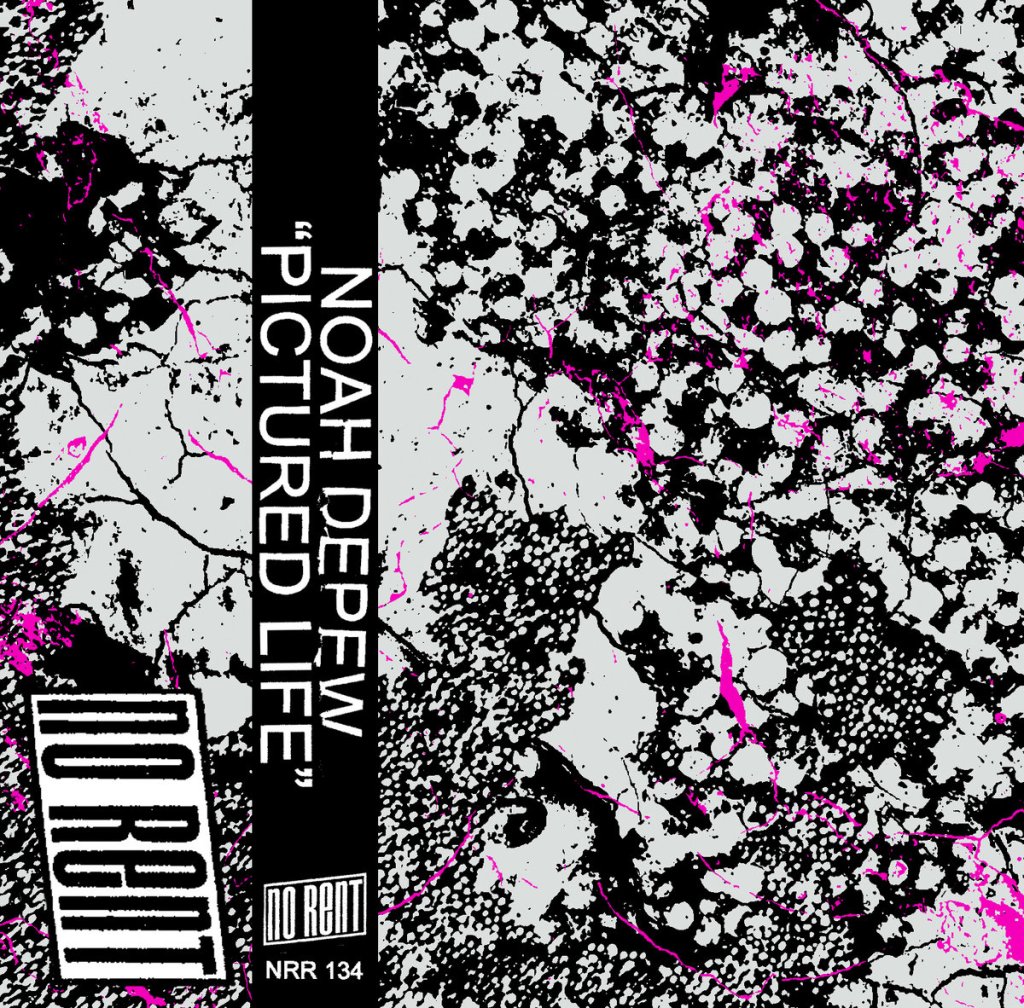
A Pictured Life is not for the faint of heart.
Music is just noise. Stick your head in a washing machine and have somebody bang on the outside of it, and that might as well be music. What? You don’t want to? That sounds “insane?” What are you, some kind of regressive, progress-hating yuppie?
No, don’t take that personally. I’m just excited, is all. I’m excited because I get to talk about one of the most full-on nutso releases I’ve ever encountered: A two song EP that will make you worried about the health of your stereo system; a pair of songs so disgusting, so torn apart, that the well-being of your ears will be constantly in question; 24 minutes of music so broken-sounding that the word music hardly even contains the semantic and lexical connotations to describe it.
I’m speaking of Pictured Life by one Mr. Noah Depew.
As far as hardlyknower can tell, Noah Depew has only released PL. No other music online bears his distinctive name.
On Spotify, his artist page displays the badge of honor:

One solitary individual listens to this album, at least on Sp*tify.
That individual would be me.
But I would wager that, were more open-minded folks to stumble across this behemoth of a release, that number could balloon greatly. Possibly to 10, or 20, or 67, or 69, or 420. And that is why I’m writing this to you right now.
See, some noise music is bullshit. Some of it is just a wall of white noise: Every frequency is occurring, all at the same time. It’s an onslaught with no breaks, no dynamics, just full on aural attack.
Everything is happening, therefore nothing is happening.
Yes, in these other noise projects, dynamics aren’t even considered; variation is an allergy to be avoided at all costs. And the cost is, namely, interest.
Pictured Life is the antithesis of this approach.
The album begins with silence. Well, not complete silence: It’s more of a room tone: A sense that you’re in a place. It does not prepare you for what it’s about to do. Then a sound like someone walking in snow appears, like a stranger approaching you in a winter field; then the stranger begins booting up a machine of some sort. Or maybe multiple machines, all working together. You have no idea what the machines are about to do, but you can sense that this mysterious man is taking this seriously – his attention is undivided.
As the machines start to warm up, you start to hear things . . . Things you can’t identify. These devices are opaque, unknowable. You can’t possibly start to understand the small squeaks and hisses. It’s quiet. You can hear the snow falling in between the small sounds.
Then, out of nowhere, the bevvy of machines begins to pour out steam – and sound. Oh, these sounds! What could possibly be happening right now!? Are they broken? Is something catastrophic starting to happen?
Then something catastrophic does happen, but the man makes no attempt to stop it whatsoever. Things begin to catch on fire, pour out sparks. But not all at once: The machines will FLARE UP then calm down. They’ll go high, then come back to a midrange. But the man has no reaction. He keeps his head down, working, creating something unidentifiable. What he’s doing is so arcane as to be almost ancient-like.
The machines pour out noise and clamor and chaos more uniformly, bucking and twisting, vibrating dangerously, and then suddenly –
It stops. Everything goes back to snow falling. You wonder what’s happened. Has the man shut the machines down? But no, he’s still twiddling the knobs, pressing buttons.
With no warning at all, the noise comes back, catapulting about your skull like a metal pinball coursing with electricity. It’s horrible! Or is it? Or is it beautiful?
But just when you’re starting to get a feeling for what’s going on, the man pulls out a sheaf of sheet metal and begins slamming it with a hammer. The metal sparks and little pieces ricochet around, falling like glitter atop the white snow.
He turns back to the machines and cranks them all the way up, nauseating you, deafening you.
And so it goes: Turn the knobs down, calm the machine down, make them squeak in a way that is surely a malfunction, but the man treats shit as a normal part of a routine operation. He seems to have no idea the degree of brouhaha he’s creating. He’s completely focused, but casually. This is his job, you’re now sure. It’s his job to make sparks fly and buildings explode. It’s just his occupation. This is all part of the plan.
But whose plan? What is the end for which these means exist?
You have no idea.
And that is the beauty. The explosions and the silences are unpredictable. They start and stop and calm down and speed up drift and warble and grind and pierce the snowy night like nothing you’ve ever experienced, and you’re rooted to the spot.
Stick your head in a washing machine filled with quarters and those Pop-Its that explode when you throw them at the ground. Do that, and you’ll experience 5% of what Pictured Life does in less than half an hour.
This album is glory in the form of destruction. It’s not an onslaught: It’s a calculated attack . . . But the calculations cannot be done by a mortal. They can only be done by the man behind these inscrutable machines.
The man pulls out objects you have simply never seen before in your life. He crinkles them, hits them with baseball bats.
Suddenly, out of the fog of snow, a crane appears. It descends with a gigantic electromagnet, nearing the man. Of a sudden, the man and his machines are lifted high into the sky, and he does not react. They’re hoisted up, above your field of view. Large rolls of sheet metal fall on the way up. You worry for the man.
But before you have time to react, both man and machines are dropped from at least 100 feet and slam into the ground. The man, again, does not react. He simply twists his knobs harder. And the machines begin to melt and disintegrate before your eyes, like a Salvador Dali painting if Dali had been high on ecstasy. No, this is not part of the plan. And yet . . .
You don’t leave. You don’t look away. You don’t stop listening. You want to see what’s going to happen.
Then silence.
Then noise.
Then silence.
Then rattling steel.
Then electronic malfunction.
Then silence.
Then fire. Then shooting sparks. Then you notice that melted snow has infiltrated the circuits of the contraption, and it’s well and truly a dangerous, dangerous place to be.
And at the last second of safety, out of nowhere, comes –
. . .
. . .
. . .
Silence.
. . .
. . .
. . .
SQUEAAAAAAAAAA
. . .
. . .
. . .
Silence.
. . .
. . .
. . .
BANG. BANG. BANG.
. . .
. . .
. . .
Then the cacophony becomes unbearable, unendurable, unimaginable, until the man begins to twist knobs backwards. The machine begins to power down. The sound diminishes, in fits and starts, sometimes shooting out sparks, other times dead silent in the moonlit winter night.
Finally, the man turns from the machines. They’re silent.
But just before he walks away, he picks up a fistful of snow, rolls it into a ball, and throws it at the machines. A noise ensues, then dies.
The man then walks away.
What have you just experienced?
You have no idea. But only one singular 24 minute experience simply is not enough. You need more. But you have no idea when the man might come back.
You don’t even know where you are.
All you know is that that was fucking amazing.


Leave a Reply