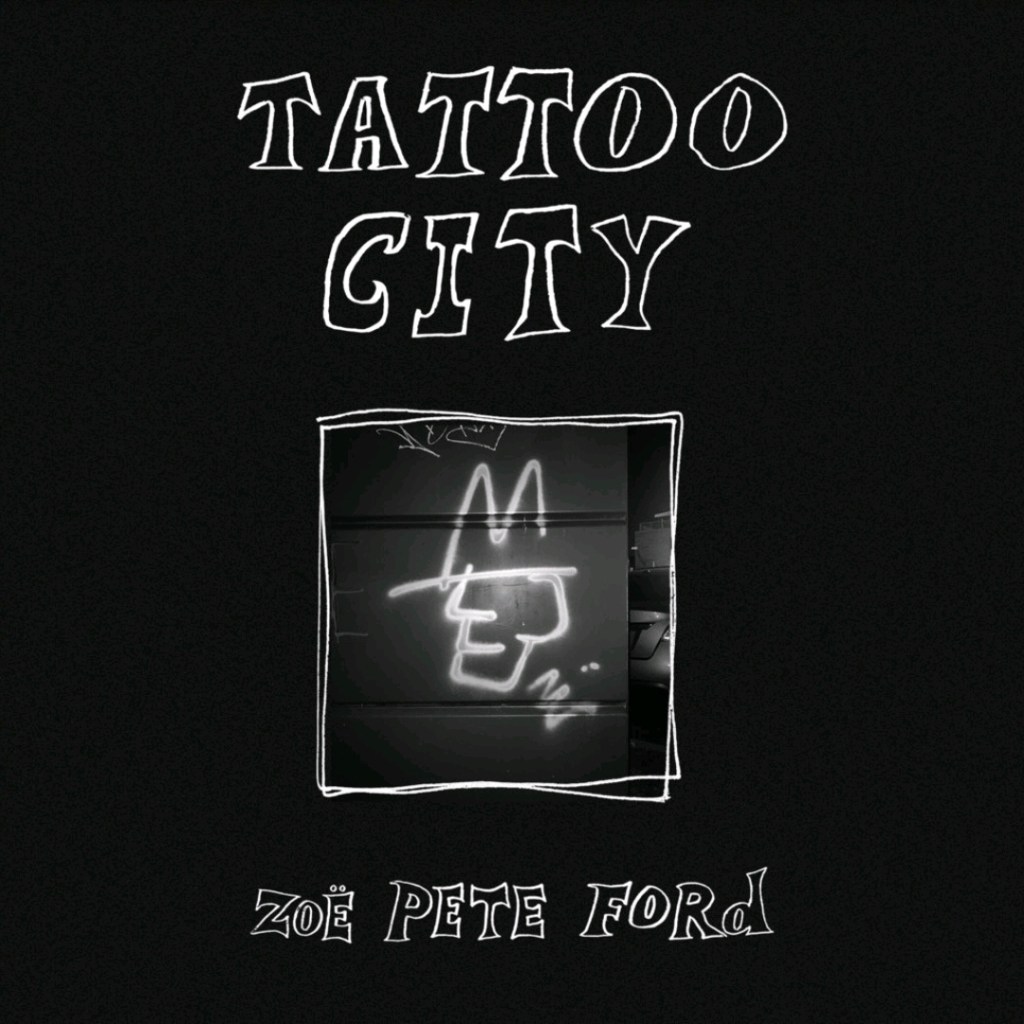
Zoë Pete Ford’s Tattoo City makes sense of blown-out desperation in a singular way.
Kris has never heard Tattoo City before.
Andre has heard Tattoo City one time.
Kris and Andre sit in a dimly lit living room in a greatly chilled state; the album begins to play. We proceed two-thirds of the way through Song #1, “Twister,” silently absorbing, before the silence is broken. But each man’s thoughts turn out to be entirely distinct from each other.
Andre: This makes so much sense now.
Kris: I don’t get it.
Andre: This is so cohesive I can barely stand it.
Kris: “Cohesive?” If this whole album is about red Chevrolets and knights in shining armor I’m not sure I can get through this. This is supposed to be fucking Tattoo City, man. Where’s the action?
Andre: What the hell are you talking about? This is action.
Kris: Look, you have a place with such a high percentage of people with tattoos that the city is renamed because of it (although obviously we don’t know whether this is an official place name or simply a colloquial phenomenon) – and also it implies that the culture of Tattoo City would be comfortable with being known as Tattoo City – which all sort of points to a group of people who probably know how to party. What’s this shit about tornados? Sure, cigarettes are cool, but it’s just not enough. It’s fuckin Tattoo City, man. Give me the rising action section, I mean, right? Cut into the fucking paint.
Andre: . . .
Kris: . . .
Andre: I don’t know if that’s a basketball metaphor or an uninformed understanding of how tattoos work.
Kris: It’s just that this first track seems pretty square for a setting like literal Tattoo City. Also, both.
Andre: You’re not getting this. I wasn’t getting it either, come to think of it. Wait until we get to the title track. It’s Song #3.
Kris: [Looks pointedly at the top of a stack of CDs.]
Andre: No, stop eyeing Desire. It’s not even Dylan’s best album from the late ’70s. We’re listening to Tattoo City and that’s the end of it.
Kris: Bullshit. And as far as this ink town, this is just good – admittedly, particularly good – alt-country-indie. We’ve heard this shit before. You’re telling me “Hurricane” doesn’t outdo fucking “Twister” as an album opener? One is quite literally a more intense version of the other, by definition.
Andre: I’m telling you – trying to tell you – that I paid $10 on Bandcamp for this album and it was worth it, and you know how I feel about shelling out more than $3 for any individual purchase, which is why I just had like two Yoplait key lime pie-flavored yogurts for dinner, so if I’m telling you it’s worth $10 – shit, probably more, just wait until “Look Good, Drive Fast” – I would appreciate if you’d surmise from the context that this shit is going to blow your hair back, so if we could just listen . . .
Song #2, “Thoughts of You,” begins playing.
Kris: I hear you. I really do. But this is just the Stones. This is, like, Exile on 2nd Street. Listen to that harmonica. Listen to that acoustic guitar. Andre, have some decency. Have some compassion. Some humanity.
Zoë Pete Ford: Now here we go again, waking up our nightingale.
Andre: [Leans forward.] Shut the fuck up a minute: She just mentioned a bird. Remember that, we’re gonna come back to that.
Kris: What the hell does “Thoughts of you put a fog upon my glass” even mean? Are we for real right now? Condensation is not caused by ill-fated romance, it’s caused by . . . You know. We all know why condensation happens, we don’t need to get into it right now.
Andre: OK, the whip-poor-will line makes sense now, in context.
Kris: I mean, what the hell are we even doing here.
Kris receives a dirty look from Andre as he reaches into a bag of Cheetos Puffs and bites into an aerated corn snack. Andre internally thanks himself for not buying the denser, far-crunchier Cheetos classic formula. He had taken several seconds deciding between the two at the dollar store earlier that day; the second half of “Thoughts Of You” is, by his estimation, only 30% less enjoyable due to the masticatory noise.
But then something exceptional happens.
Song #2 comes to a close and gives way to the title track of Tattoo City. Namely, “Tattoo City.”
As recording artist Zoë Pete Ford yells, “A-WON, TEW, TREE, FAW,” Kris stops with a Cheeto Puff frozen just an inch from his open mouth. He looks at Andre. An electric guitar begins stabbing through the previously relatively-undisturbed living room.
Kris: Is this . . .
Andre: Yes.
Kris: . . . Action?
Andre: It’s action, Kris. We made it.
Zoë Pete Ford: In beer sign light I feel pretty / good, until I get to feelin’ bad.
Kris: Damn.
Zoë Pete Ford: . . . And the razor’s rackin’ those lines again.
Kris: Oh, fuck yeah.
Andre: Fuckin’ Tattoo City, right?
Kris: Oh yeah, Tattoo City. I get it now. We started on the outskirts. We had to get into the municipal limits. We’re so here.
______________________
For this reviewer – as for Kris above – this album didn’t really get going until Track #3. At least, on first listen; on second listen, something else happens. Let’s talk about it.
Zoë Pete Ford has done something fairly remarkable on the grungy, tapestry-like1 Tattoo City: She’s recorded an album such that you’ll like each consecutive song more than the previous song.
To put it plainly – if you aren’t sold by Track #1 or Track #2, then #3 may get you. If #3,#4, and #5 leave you hanging, #6 will pull you back up, et cetera.
Which isn’t to say that the album goes from bad to good, nor that it goes from good to great; rather, each subsequent song further signifies the validity of Tattoo City‘s existence as an album.2
In the course of 37 story-laden minutes, Ford’s album justifies its own creation; once you see that justification, the entire thing starts to make sense.
But here’s the thing:
In order to be convinced of this, the listener must hear the entire thing; if you stick around to the end of the final track, the bizarre and transcendent rendition of “LA Freeway,” (which we will be talking about far more later on), you’ll understand that this is3 a powerful, real, album’s album. If you don’t, the tapestry will be left morbidly incomplete.
Which would be a damn shame.
You may ask, “Why can’t a sampling of the songs suffice? Who the hell’s got 37 uninterrupted minutes these days?”
Because:
On Tattoo City, Ford is not playing it safe. She’s walking a high wire, trying things that – described objectively – may seem catastrophic.4 Listening to this album feels like watching her try to make her way from the top of one very tall building to another, while you’re constantly worried she’s going to absolutely eat shit.
Hearing her get to the end mostly unscathed is a thrilling experience.
______________________
Track #4, “Truckstop,” begins to play, a departure from the previous shitkicker. An acoustic guitar plays a country sequence and a fiddle sings in the left speaker. The only other thing present is what sounds like tape hiss.
Zoë Pete Ford: Mama, I can’t get out of bed.
Kris: . . .
Andre: Kris, buddy. Stay with me.
Kris: I’m . . . I’m willing to hear her out.
Andre: I promise this is still action.
Kris: It doesn’t sound like action. It sounds depressed. Is there depression in Tattoo City? Is that what she’s trying to tell us?
Andre: Every city has its problems, Kris. Don’t be naïve.
Kris: Apparently there’s violence and overdoses and theft in Tattoo City as well. I’m not saying it’s not action . . . It’s just, I think I’m experiencing empathy for the citizens of this place, and it’s making me somewhat uncomfortable in a way I wasn’t expecting.
______________________
Yes, “Truckstop” is the moment of departure in which we start to understand that this album is fundamentally a series of consequent departures. We will be staying inside city limits, but we’ll be seeing the whole place.
We start to understand that not only is Tattoo City a place to get drunk, a place teeming with neon lights, a place for romantic encounters to go sideways – it’s also a place of deep pain. In fact, for those drinks and glowing signs and dalliances to exist, so too does the pain have to be there. One without the other is not a complete picture.
. . . And as always, Ford is not one to give us an incomplete picture.
(Also as always, we get wordplay that deserves a specific exploration; wordplay like, “Lust for life and doghouse roses,” used in the description of the titular truck stop. Why is this interesting? Well, check this out: “Lust For Life” is the title of both an Iggy Pop song and album – in the song, he proclaims: “Quit beatin’ my brain / with the liquor and drugs.” Now, right away (in the Ford song), our character talks about reds, blues, greens, and whites – namely, drugs;
Doghouse Roses is the title of a Steve Earl story collection. Yes, the beloved country singer also writes prose. In this song, Zoë Pete Ford uses it to mean, presumably, “Flowers a man gives to a woman after she puts him in the doghouse, i.e., after he does something that makes her mad.” At least, that is this reviewer’s interpretation. Both of these references together connect punk legend Iggy Pop with the more prominent countrified aspects of Ford’s music. Which is pretty cool.)
______________________
Back in the living room, our two friends sit awash in the end of “Truckstop;” Kris internally wonders if Tattoo City is as desirable a locale as he had initially imagined.
Then, a pair of double-tracked acoustic guitars, a mellow bass, and a tight drumkit emerge from the JBL speaker sat on the fireplace. Andre squints his eyes, trying to remember what happens next; Kris sits in uneasy anticipation.
Neither man says a word.
Zoë Pete Ford: You can hear my snakeskin boots echo as / I’m walkin’ through the hall / With my hat on I scrape the ceilin’ / You’ve never seen a man so tall . . .
______________________
“Snakeskin” is the specific place on Tattoo City at which the internal guards went entirely down. I stopped wondering if the album could justify itself – stopped questioning whether Ford could sustain a sense of intrigue throughout the twelve songs. “Snakeskin” makes these questions irrelevant.
Why?
Because of the chorus.
Because of the chorus.
But let me back up. In “Snakeskin,” Ford sings as a man. (Which is a replete theme throughout both Tattoo City and her previous record One Of The Guys. Often, you’re either not sure what gender the narrator is, or the gender of a character will be ambiguous, or she’ll straight up tell you that someone vacillates between masculine and feminine.)
She portrays her/hisself as “kind of painful handsome,” describes her/his battles against addiction, self-defeating ways of living, brushes with near-death at the point of a pistol in “every state South of Arkansas.” All of this occurs over an almost droning, somewhat hypnotic progression, and it sells the rambling atmosphere of what Ford’s character is telling us.
But then – and here’s the important part – a distorted noise takes up space atop the instrumental, and we get to the chorus:
“But put me behind a microphone, and you’ll know that it isn’t pretend;
put me behind a microphone and I’m more than your fairweather friend.”
To understand why this is such a big moment, we have to understand something about the creative mind: Pretty much every creative person feels better about themselves while actively in the moment of creation than they do at any other time.
In fact, many of the creators in hardlyknower‘s circle lean dangerously toward (or dangle over) a viscous vat of self-hatred when not writing songs, novelizing, painting, sculpting, etc.5
So the strength of this chorus, rather than it being a singalong earworm – though that’s arguable – is that you don’t know who’s singing it. Is it the man in snakeskin boots, or is it Zoë Pete Ford herself? Knowing nothing about her disposition other than what’s on her albums, we couldn’t tell you. But the brunt of it is that a large swath of all creative people could sing these lines and have them be true.
That’s good fucking writing.
Immediately after this, we’re treated to “Waiting For A Bus” . . .
. . .
. . . . . . . . . . . . . . . .
. . . Let’s be blunt: It’s apparent from Ford’s music that she’s cultured, that she knows her way around a proverbial record store, that she’s been around the block of obscure-ish musical artists – and with that in mind, there is no fucking way that she doesn’t know this song sounds like Neutral Milk Hotel’s In The Aeroplane Over the Sea. Not a single chance. If it turns out that she does, I will turn in all of my previous earnings from this website to the first person who proves it.6 Which is not a bad thing, it’s just a thing.
“Waiting For A Bus” is also where an overarching theme comes into focus: Desperation. Not knowing if you’ll ever get to where you’re trying to go. Maybe not even knowing where you’re going. “Waiting and fading by the light of the setting sun, swingin’ a dollar store wallet chain, thinking of you to pass the time.” Indirection, unsureness, insecurity in every sense of the word – all laid out amidst a blare of blown-out acoustic guitar, fuzzed-up electric guitar, bombastic drums, and a litany of layered background vocals.
The song seems to be asking, Where do we go from here?
______________________
Side A of Tattoo City spins to a stop. Kris and Andre sit and compose themselves.
Kris: Is the rest of this still going to be good?
Andre: Hand me those Cheetos Puffs. That really took it out of me.
Kris: [Stands up to flip the record.]7
______________________
If the first six songs of Tattoo City were a process of the album convincing us it’s worth listening to, the latter six songs are a process of everything we thought we knew about the album absolutely disintegrating.
First, we have “Call On You.” Which, let’s get this out of the way:
______________________
Zoë Pete Ford: Did I hear your whistle from over the hill? Was it a chuck-will’s-widow or a whip-poor-will?
Kris: Birds.
Andre: What’d I tell you, man?! Fuckin’ birds. Told you we were gonna come back to that shit.
Kris: I have no idea what she’s doing, but I’m enjoying it.
______________________
Yes, birds. The three birds we’ve heard so far are the nightingale, the chuck-will’s-widow, and the whip-poor-will. Now, the nightingale is diurnal, but it’s most active in the twilight hours; the other two are nocturnal birds.8 The fact that these two night-dwellers are mentioned in “Call On You” makes narrative sense: “The bugs all cry in the thick porch air, and in that dark I want you there,” sings Ford – the song literally happens at night, which compounds the generally forlorn aspects of the song.
But beyond the temporal aspect, both of the nocturnal birds are considered by certain cultures to be foreboding omens. The Chuck-will’s-widow is, in European tradition (though not Native American, Mexican, Indian, Chinese, Japanese or African) a sign of impending death and doom; the whip-poor-will is, in some cultures, thought to be a psychopomp, “a conductor of souls to the afterworld,” with H.P Lovecraft describing them this way: “If they can catch the fleeing soul when it leaves the body, they instantly flutter away chittering in daemonic laughter; but if they fail, they subside gradually into a disappointed silence.” From the general haunted ambiance of “Call On You,” it should be understood that this nighttime birdsong doesn’t bode well for our narrator.
This is just very, very Lead Belly-esque,9 very 1920s South; it circles around a resonator guitar, fingerpicked, and embellished with a ringy, distorted drumkit, as Ford sings, “I call on you / when my head hangs low / in the dead of night / in the neon glow10 / I call on you / when my head hangs low / and sometimes when my head / hangs high.“
That “neon glow” thing is recurring throughout the record, as are references to sunset; take this in concert with the nocturnal/twilight-preferring birds, and it seems that Tattoo City is an album concerned with the transition to night in addition to night itself . . . the oncoming nightfall cannot be staved off. All we can control is what we do inside of it.
But then we get to “Swearin Off Love.” This exactly-one-minute song is simply Ford, an acoustic guitar, her voice, and two phased-out, modulated voices coming from the far left and right. It sounds weird. Possibly the weirdest thing from ZPF so far on this album. And yet . . . It slams. It has something exciting to it. The song, which espouses the narrator’s interest in lust, but not love, contains the refrain “If you’re the cops, then I’m the drugs.“
“I don’t want you to find me“? Is that what she’s saying?
Look at the romantic misfortunes described earlier in the record: “Swearin Off Love” is the natural progression, and it’s done with a detached, resigned, yet resolute air.
Okay. We’re in the home stretch here. I’m aware this review is stretching to Odyssean lengths, but we’re almost to the crux – and to get to the crux, I’m going to skip the song “Priestess”11 and move on to the aforementioned “Look Good, Drive Fast.”
Listen.
I fucking love this fucking song so fucking much, holy fucking shit.
It’s fantastic. It swaggers in a way very few bands can swagger. I could reference Led Zeppelin, Black Sabbath – hell, even a slower Deep Purple – but it’s its own thing.
It’s a great song.
Now. With that in mind:
I saw ZZ Top live once, and they were really, really wasted, and I can tell you with absolute confidence that “Look Good, Drive Fast” is basically that specific ZZ Top concert if it hadn’t been total ass. I don’t mean that “Look Good, Drive Fast” is like regular ZZ Top records (which are really fucking good, and tight, which should give you a clue that drunk ZZ Top is still pretty rockin’); I mean if those three totally wasted guys had somehow sounded really, really good and authoritative while they were totally wasted, they’d sound like this song; I also don’t mean that Zoë Pete Ford sounds drunk on “Look Good, Drive Fast” – like, think about it: Sober, she sounds like drunk ZZ Top. But not drunk herself. It’s by incredible coincidence that a ZZ Top and a sober ZPF sound so incredibly similar, but only if ZZ Top hadn’t sounded bad while they were drunk. Am I digging myself in a hole here?
Look: If you like rock ‘n’ roll, this song is a must-listen. Even if the rest of this review sounds totally unappealing, you have to listen to this song. It’s one of the best straight-up rock songs in the past 15 years, and we’ll say that with our whole chests behind it.
“LG,DF” is an account of a woman who goes out walking at sunset12 and sees a really hot dude in a really hot car, and they say, “Yeah, we’re both hot,” so they get together and break speed limit laws at will, then they’re together for a while, but the lady (who is hot) gets tired of the speed freak guy and leaves, because “Look Good, Drive Fast” is ultimately a song about the very deep theme of rocking and fucking rolling.13
Now.
If you want to actually read about the album, you may want to skip ahead of this next heading right here and go to the next heading. We’re about to get to the song “Easier,” which means we have to talk about something venturing fairly far from where we should be heading, but which I think I have to express. And that is
Entirely my problem:
I have a weird disposition to certain musical elements, and it makes me angry.
I’m angry with myself about this, and I’m also angry with the song. I’m not angry with Zoë Pete Ford, because this is frankly not her issue whatsoever. This really is nobody’s problem but mine.
But.
I must confess something.
I don’t like clean electric guitar.
It angers me on an existential level. It offends my sense of decency. Which is not to say that clean electric guitar is objectively bad, or that I’m right to feel like this, because I’m absolutely not. I’m just saying that for me personally, the minimum amount of distortion I can accept from an electric guitar while I believe it can rightfully be called an electric guitar and not just an underutilized magnet slapped on a14 grotesque, maladapted stick of maple, is the song “Good Times, Bad Times” by Led Zeppelin. Go listen to it. It’s not even that much distortion. That’s my line. Anything less, and the most I can do is tolerate it or consider it a harmless nuisance at the periphery of my attention. Sort of like most 50-60 year old couples I know, I can live with it, but I will never love it.
So, with that out of the way, let’s get back to the music. No more personal vendettas.
Easier, Cont.
I felt that, arrangement-wise, the song would have been objectively better aesthetically suited to piano rather than clean electric guitar. Other than that, “Easier” finds our narrator sitting at a train station, going somewhere, but not sure where.
______________________
“Easier” draws to its conclusion, with Kris marveling over the way Zoë Pete Ford sang the line, “I’ve been stranded on this / train platform / But I’ve been stranded / since the day I was born.” The genuine pain in her voice affected him greatly.
Kris: Was that the last song?
Andre: No, man. One more. You’re not gonna believe this.
The opening notes of “LA Freeway” crash out of the JBL, nearly shattering our boys’ eardrums. Kris looks at Andre in disbelief. Andre grins like he’s played a practical joke. The two sit in silence for three minutes and fifty-one seconds.
______________________
“LA Freeway,” a Guy Clark-penned masterpiece, is a fairly calm song. Guy Clark played it quiet, told stories about grapefruit trees in the middle; Jerry Jeff Walker amped it up a good bit, but he couldn’t make it not easy listening – all versions I’ve heard are fairly good, because it’s such a good song that it’s hard to fuck up.
Zoë Pete Ford does absolutely everything in her power to fuck it up.
If you’re planning on listening to this album, go listen to it now. Or go listen to this song. I almost feel bad spoiling it. It’s incomparable.
OK. Ready?
I feel about this recording the way Lester Bangs felt about “Wooly Bully.”
The entire song is Ford playing a completely fucked up electric guitar, bashing the shit out of the strings through what is obviously multiple layers of distortion and fuzz and overdrive and percolation, while she wails the lyrics to “LA Freeway” overtop. Her voice is also saturated. Obviously.
It’s the most pissed-off version of “LA Freeway” we at hke have ever heard, probably because it’s the only pissed-off version that we can find. The closest thing available is an unheard cover by two artists named Buckstar and Steve Carew, which is truly ridiculous. But Ford’s version is ridiculous in a different way. It’s a complete departure from everything you’ve ever thought about the song “LA Freeway,” or covers of country songs, and especially everything you know about Guy Clark.
It’s truly insane. It doesn’t make any sense. It’s not faithful to the original song.
And yet?
It’s perfect. It’s a perfect recording. It’s a perfect end to the album. For an album so laden with desperation, preceded by a song about waiting at a bus station, ending it with a hopeful song about leaving – but making it sound like it was put through an extremely dangerous house fire – is exactly the right choice.
Wrapping it up
Just to mention: I believe you could call this a concept album. It’s got a narrative arc, it’s got a setting, it’s got places to hang out, it’s got vivid characters – it even has a sense of time.
For the purpose of a correction to our previous article, One Of The Guys was not Zoë Pete Ford’s sophomore album, and it turns out that Tattoo City is not Zoë Pete Ford’s junior-year album, either.
Now – they are, respectively, the second and third “Zoë Pete Ford” albums, as a moniker – but Ford – as a human being – has a whole ‘nother persona through which she releases music: She’s self-recorded two more albums as “superbluesurf,” which puts her total number of LPs at FIVE (5), plus a smattering of EPs and singles.
All of these releases have taken place in the past five years.
We’re not going to get into all the details of what ZPF has done to change her sound or her songwriting or her recording quality. All of this is simply to lead up to the point that Zoë Pete Ford, on Tattoo City, sounds sort of like (bear with me) the contents of a 10-year-old barrel of bourbon, which barrel is made of new oak, perfectly charred to a depth of 1/4″ and filled with 120 proof white lightning, distilled from a mash of at least 51% corn, a little bit of wheat, and some rye, then titrated down to exactly 50% alcohol.
Matured, is what I’m getting at, in the same way as a really good handle of bottled-in-bond booze. Her music has gotten darker, more complex – but also smoother.
I’m not sure if you can call Tattoo City a “perfect” record. If we gave number ratings on this site, I wouldn’t be able to give it a number. Because I don’t think it’s trying to be perfect; I think it’s trying to be itself.
And that is why this album justifies its own existence: It exists as itself, not anything else. It’s like Ford and her collaborator Mike McCarthy15 didn’t even try to make anything: They just sat in a room until it appeared, fully formed. That is, if you can’t recognize it, pretty high praise.
And because it’s so singular, because the narratives are so dense (even denser than on One Of The Guys), because it’s a high-wire act, if you listen to it once, you’ll probably like it; if you listen to it more, it’ll get better and better. But for the love of God, listen to the whole thing.
______________________
Andre: It’s so much better the second time.
Kris: Can you play that again?
Andre: No, I have to go to the store.
Kris: What? It’s 10:30 at night. Why?
Andre: Because you ate all my Cheetos Puffs, and I want Cracker Jack.
Kris: Shit, I bet Zoë Pete Ford eats Cracker Jack.
Andre: Yeah, prolly.
______________________
Tattoo City will be out on streaming 22 October 2026, but if you want to hear it before then, it’s worth the $10 price of admission on Bandcamp.
- And “tapestry” holds two functions here: First, the album is a bunch of wildly different vibrations woven into one document; second, a tapestry often depicts a broad story across its thousands of decisions, which Tattoo City absolutely does. ↩︎
- Some albums simply don’t convince you that they needed to be brought into reality. They just say, Here I am, like me!, but don’t ever really win (or attempt to win) the debate in which the winning side would be the verdict of, The world is better for having this album in it. Albums like this simply exist because someone made them; better albums exist because they were supposed to be made. They are inevitable. There’s no way the people who made them couldn’t have made them. ↩︎
- – like her previous release, One Of The Guys – ↩︎
- We’re being purposefully cagey here. If you want a concrete example of this, and you’re willing to shell out even this early in this review, go listen to her “LA Freeway” and you’ll see exactly what we mean by this. Seriously, it sounds fucked. ↩︎
- Why is this? I don’t know, take it up with God. Or your mom. ↩︎
- (This website is in the red, man. If you do this, you will be in debt.) ↩︎
- There’s actually not a vinyl release of Tattoo City, though there really should be. ↩︎
- Remember the Light of the setting sun line from a few paragraphs up? We’ll come back to this. ↩︎
- AKA Huddie William Ledbetter, one of the greatest blues/folk singers of all time. ↩︎
- Emphasis ours. ↩︎
- Which is a drum machine-driven, heavily-echoed description of two people in a restaurant (or perhaps bar) at sunset, and the narrator wants to cry, so she goes into a photo booth and weeps, for some sort of reason. Possibly a breakup. Possibly depression. Possibly abuse. We’re not quite sure. It does contain the line, “You look like buzz lightyear in your turtleneck,” which is just fucking awesome. It’s a great song. But we have to move on. Right now I’m at almost 3,000 words. It seems excessive. Is it excessive? Let me know in the comments. ↩︎
- Which is precisely where the previous song concludes, by the way. ↩︎
- Other stuff too, and it fits really, really well into the album – but frankly, it rocks too hard to cheapen it with lyrical analysis. Just make a stank face to the riffs and hit repeat. ↩︎
- And remember, I am completely aware that I am wrong about this. ↩︎
- Producer, who’s worked with Spoon, . . . And You Will Know Us By The Trail of Dead, Heartless Bastards, and countless more. Make no mistake, this album is a masterclass in recording engineering. McCarthy knows exactly what he’s doing, and he does it perfectly. We at hke cannot give anything but praise to this man for his contribution not just to this record, but to music as a whole. God bless you, Mike McCarthy. ↩︎


Leave a comment