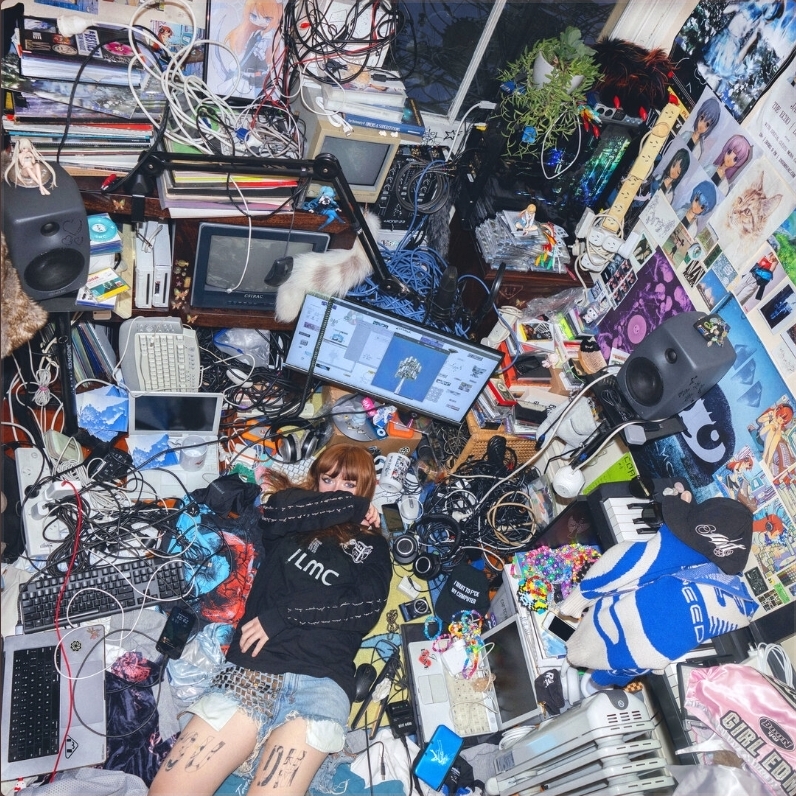
This Ninajirachi song is the perfect portrayal of what music-making feels like.
I am currently crying. Why?
Because:
We all gotta start somewhere; and usually, when we start – no matter what we’re starting – we kind of suck. From the production on the Ninajirachi record I Love My Computer, it’s clear that the Australian producer is well past those awkward days. She’s seemingly able to do anything, from the glitched out “London Song,” to the lush “Delete,” to the digital explosion of “Battery Death,” never faltering for an instant, never unable to express a thought or actuate a sonic landscape.
But on Track #10, she recounts those early, unformed days:
“I used to look the lyrics up and Google, ‘What’s a chorus?‘
I wrote some of my own and used Garageband to record it . . .”
I think every musician remembers their earliest recording days: Whether they were screaming into a cassette machine or strumming awkwardly by an iPad microphone or fighting with a tiny, cheap interface . . . The moment you realize, I’m actually able to make something, and that something can be real, and it will exist forever, you realize that you can be a musician. You can do it all on your own. You can create something eternal. You can exist on someone’s MP3 player, you can be inside another person’s headphones – you can create a magic spell that lives outside of you.
And you might even like the way it feels.
You can create anything you want, no matter how far-fetched, no matter how out-there, and no one can stop you. In this moment, you are totally, completely free, no matter how good or bad you might be. This is you.
This is you. Do you understand?
You are a singularly unique person, with your own experiences and feelings and wants and hates, and you can use every part of yourself, express every part of yourself, in a way that by definition no one else can. Not a single other person in the world, in history, can do what you’re doing right now. Not in exactly the same way. Maybe you use a common chord progression, you set your tempo to 120 BPM, you steal a little vocal phrase – but no one, ever, will do it in exactly the same way as you are doing it right now.
Ninajirachi recounts a music class assignment, “to write a little song, no real rules or gear requirement.” She “can’t really play good,” but she has a computer. It’s her instrument. She’s “put in the practice,” so she just uses that. For whatever reason – maybe a bias against electronic music by a traditionalist teacher – she gets a 40%. But that doesn’t matter.
“‘Cause it meant I knew something they didn’t.”
The computer is important in this song, as it is in all of Ninajirachi’s work: It’s as much an instrument as a guitar or a flugelhorn or a drumkit or a human voice. Not everyone gets that – if something allows you to create music, it’s an instrument. If it’s important enough to you, it may even be sacred. There’s a reason people refer to their guitars by name; there’s a metaphor in the fact that people buy plane tickets for their cellos; there’s a poignancy in a girl in rural Australia hunched over a blue screen struggling with software; there’s a miracle in any method of creating sound.
Music is the decoration of silence.
Do you understand this?
If no one ever made music, the only things we’d hear would be nothingness, or the wind in the trees,1 or the sounds of humans speaking words, or the sounds of backhoes digging another goddamn parking lot, so we can hear the sounds of idling cars. Music offers an alternative: What if we turned this nothingness into somethingness? What if we made it beautiful?
It doesn’t matter if you “can’t really sing good.” It matters if you want to try it. It matters if you want it. It matters if you love it. It matters if you like the way it feels. It matters if you want to feel that way over and over and over again. It matters. Music matters. Not just to the person listening to it, but the person making it. It’s hard to describe how much it matters. It’s hard to really portray how fucking incredible it is that we live in a world where humanity has decided we’re going to spend our time and money and lives and emotions on an art form that isn’t strictly necessary for us to wake up and eat and sleep and work and shelter ourselves. We don’t need it.
But we need it.
Humanity as we know it is not the same without music – and the people who make this music are not the same people without creation. Think about all the joy you’ve derived from this, this strange painting of invisible waves atop the ambient soundscape of life; think about how different you’d be if your favorite band hadn’t written that song you listened to on repeat when you were young, allowing it to soak into the porous fibers of your soul and soften and stretch your existence into something more beautiful and open. Think about the courage it’s given you, the acceptance, the catharsis, the love, the things you can’t even name because they’re too important and big and personal and you. You would not be the same without music.
“If something really feels good, why, then, would I fight it?”
And we don’t fight it. Not in any real way. Maybe we avoid a song if it makes us sad, or we dislike a band. But music? We don’t dislike music. As a species, we’ve chosen it as what makes us what we are. Think about Voyager 1, deep in space – what did we put on it to represent us? A record. A golden album. On it are speeches, yes, but also songs. Some of the most beautiful, meaningful songs ever recorded. Chuck Berry and Louis Armstrong and Blind Willie Johnson – people who fought, had to fight, all through their childhoods and adulthoods, who faced hardships and pain and struggle and grief and death, and yet who made music so meaningful that we thought it right to send out to the stars themselves.
“One day, when I’m older, I might do something else,
but I’ll still write the stories, and I’ll sing them to myself:
I’ll sing them in the kitchen; I’ll sing them when it’s quiet –
’cause when the melody is meant for me,
I’m gonna find it.”
And that’s the thing, isn’t it? There are melodies meant for all of us, and when we find them, it’s like nothing else in all of existence. Be we a music maker or a music listener, when the right string of notes hits your ear, stimulates your brain, something happens. What is that? We don’t really know. I don’t think we’ll ever truly know. The essence of music is unknowable, even if some can describe it, can quantify it. Part of it, the most important part, will always be a secret. It will be a secret that we know individually, maybe even with lovers or friends, but can never speak. The secret is that part that tears us down and rebuilds us as something stronger in ways we can’t ever speak out loud.
“I sit out on the balcony with my oldest friend,
the spirit in the room with me that carries my pen.
’cause I can’t really sing good,
but I’m still gonna try it,
’cause I like making music,
and someone’s gotta write it . . .“
The spirit is real. I don’t know what it is. I don’t know how it works. But I know it’s there. And if you make music, you know that spirit too. You can feel it with you as the first straining notes leave your lips and fingertips and bones. The spirit carries your burdens uphill with you as you struggle through. The spirit guides your hand as you fret notes and write the words that go with the melody the spirit has given you. The spirit allows you to say things you didn’t even know were sayable. The spirit is what you pass on when you put your songs to tape, spreading as far as it can – but the spirit never diminishes, yet grows stronger the more times it’s heard and shared and experienced.
The spirit is where the music comes from and where it lives. That is why it is unknowable; yet its unknowability is precisely how it succors and sustains and heals us.
This is why we create for our whole lives, why we listen for all our time on Earth, why we dance, why we cry, why we sing at the tops of our lungs and move our lips soundlessly in public, our ears stopped with tiny speakers that give us life. This spirit is accessible by all who seek it, no matter their talent, their goodness, their strength or weakness. This spirit is why we are human.
And yet, we only know it because . . .
“‘Cause I can’t really sing good,
but I’m still gonna try it,
if only ’cause I like the way it feels.”
- Which is, in a way, a natural music. ↩︎


Leave a comment